
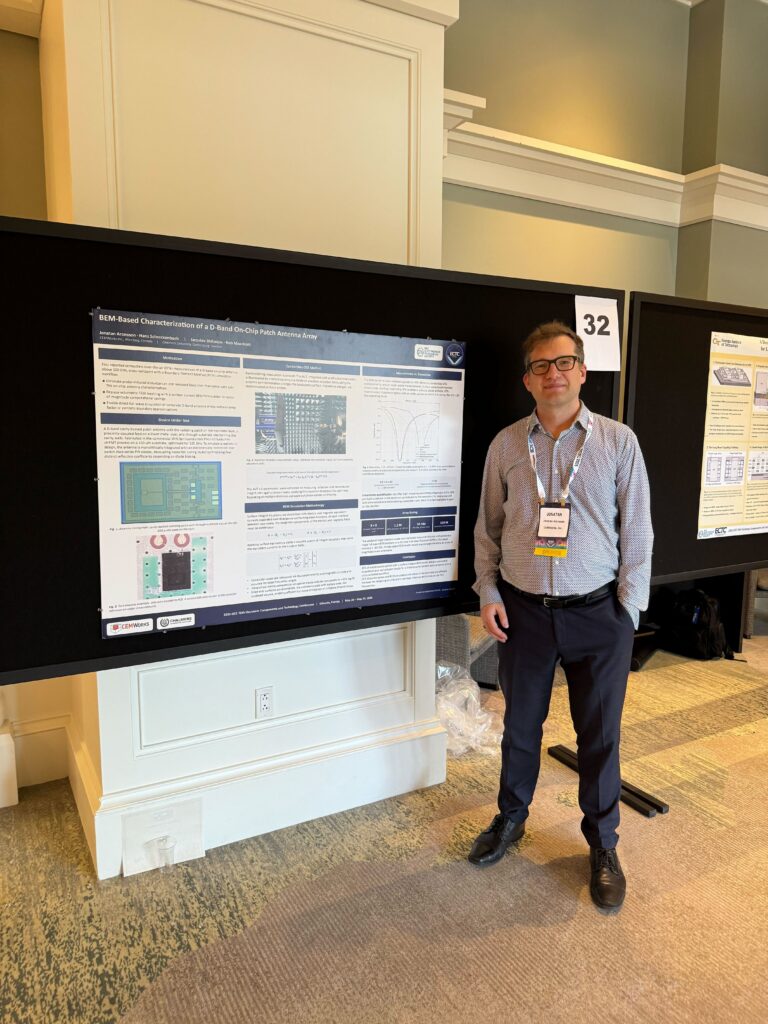
CEMWorks recently participated in ECTC 2026 in Orlando, Florida, where Dr. Jonatan Aronsson presented research on the characterization and simulation of D-band on-chip antenna arrays.
The paper, titled “BEM-Based Characterization of a D-Band On-Chip Patch Antenna Array,” was authored by researchers from CEMWorks Inc. and Chalmers University. It focuses on a growing challenge in high-frequency electronic design: how to accurately measure and simulate antennas that are integrated directly on chip.
As wireless and sensing systems move toward sub-THz frequencies, antennas are increasingly being integrated with chips, packages, and other electronic structures. This creates new challenges for both measurement and simulation. At these frequencies, even the measurement setup can affect the antenna behaviour. Traditional on-wafer probes can disturb the emitted field, while rerouting the antenna signal to external connectors can introduce additional uncertainty.
The research presented at ECTC explores a different approach by combining contactless over-the-air measurement with a Boundary Element Method simulation workflow. The contactless measurement method allows antenna impedance and realized gain to be extracted without disturbing probes or rerouted feed lines. In parallel, the BEM simulation approach models surface currents on conductors and dielectric interfaces without requiring volumetric meshing.
This combination creates a mutually validating workflow. Measurements help confirm that the simulation reflects real-world antenna behaviour, while simulation provides additional insight into how the antenna performs under realistic design conditions.
A key part of the work is scalability. Because the BEM approach discretizes material interfaces rather than the full surrounding volume, it reduces computational complexity while maintaining accuracy. This makes it possible to simulate complete D-band antenna arrays directly, without relying on common approximations such as array factors or periodic boundary conditions.
The paper also demonstrates the approach on an 8 by 8 antenna array, solved as a single full-wave BEM simulation. This highlights the potential of BEM-based simulation for practical analysis of larger on-chip and in-package antenna systems at sub-THz frequencies.
For CEMWorks, this research reflects our continued focus on advanced electromagnetic simulation for next-generation electronic systems. As chips, packages, antennas, and high-frequency structures become more tightly integrated, accurate and scalable EM simulation will play an essential role in reducing design risk and supporting future technologies.
CEMWorks is pleased to contribute this work to ECTC 2026 and to continue advancing simulation methods for on-chip and in-package antenna design.